An Art Journey with Isa

Exploring Art through Places, People, and Time — Moments that Inspire.

Author: Isabelle Le Dren

  • Klimt at the KHM

    Klimt at the KHM

    When you think of Gustav Klimt, you think of golden shimmer, ornamental patterns, and those unmistakable portraits like The Kiss or Judith. That’s why it surprised me to learn — only recently — that Klimt has a quiet presence in the Kunsthistorisches Museum (KHM).

    Not with one of his iconic paintings, but in the very fabric of the building itself. In 1890, when the museum was nearing completion, the young Klimt, together with his brother Ernst and their friend Franz Matsch, was commissioned to decorate the grand staircase. They painted eleven spandrels and lunettes, filling the soaring interior with allegories of ancient civilizations and the history of art.

    I have to admit, I walked past these paintings several times without really noticing them. They don’t call out with gold or modernist daring — they blend into the marble, mosaics, and gilded ceilings. Yet once you know they’re there, it feels like a secret connection: Klimt’s hand, already showing a sense for detail and drama, hidden in plain sight.

    For me, it was a reminder that Klimt didn’t emerge out of nowhere. He trained, collaborated, and painted within the conventions of his time before breaking away to become the star of the Viennese Secession. Standing in the staircase, you can almost sense the tension between tradition and the new — a foreshadowing of the artistic revolution to come.

    Have you ever discovered an early work of a famous artist that changed how you see their later masterpieces?


    Special Insights ✨

    • Klimt’s group was called the Künstler-Compagnie; they took on commissions for theaters, museums, and public buildings in Vienna.
    • The staircase paintings at the KHM depict ancient cultures: Egyptian, Greek, Roman, and medieval art.
    • Ernst Klimt died young (1892), Franz Matsch stayed more traditional, while Gustav became the radical innovator.
    • Together, their work still adorns not only the KHM but also the Burgtheater in Vienna.
  • A Sunday at the Kunsthistorisches Museum (KHM), Vienna

    A Sunday at the Kunsthistorisches Museum (KHM), Vienna

    A Sunday at the Kunsthistorisches Museum (KHM), Vienna

    Vienna is a city of layers: imperial grandeur, fin-de-siècle innovation, and, tucked into its palaces, the roots of modern art. Last Sunday, I set myself a small challenge: to look beyond the famous masterpieces at the Kunsthistorisches Museum (KHM) and discover something less obvious. The KHM, after all, is best known for its Rembrandts, Rubens, and Vermeers, but hidden among its rooms are quieter works that rarely get a spotlight.

    With ChatGPT’s help, I arrived with a list of paintings that are often overlooked:

    Finding them turned out to be its own adventure. The KHM is vast, and floor plans showing the painters/period. But one helpful supervisor directed me to the online database on their website (the link of those images above).

    These “hidden” paintings are sometimes literally hidden: small canvases in side rooms or tucked between giants. After some wandering, I finally came face to face with Titian’s Christ and the Adulteress.

    What struck me first was its modest size. In a museum where walls are dominated by monumental altarpieces and enormous mythological scenes, this painting felt almost intimate. Titian shows the tense moment when Christ confronts the accusers of a woman charged with adultery. The gestures are restrained, the figures clustered closely, and the emotional charge lingers in the space between them. No thunderous drama, no theatrical sky — just a quiet intensity.

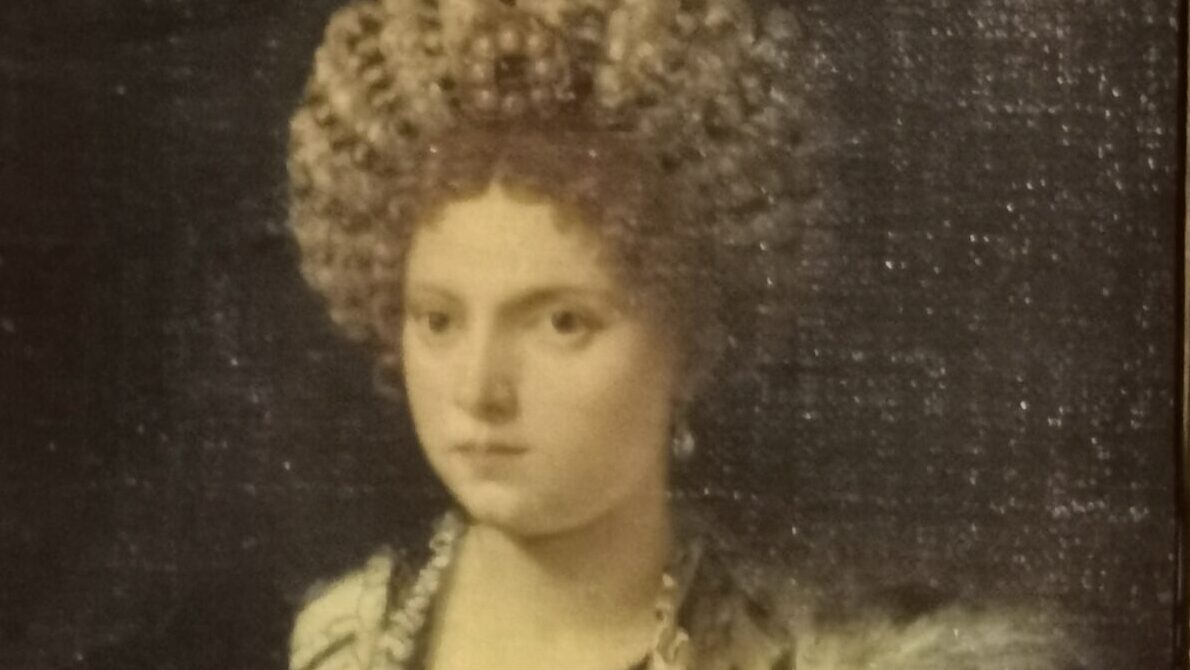
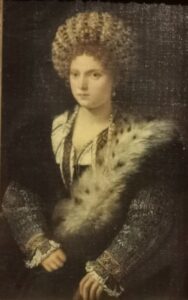
    Portrait of Isabella d'Este (ALT)
    Portrait of Isabella d’Este (Caption)

    And yet, the work that truly stayed with me that afternoon wasn’t even on my original list. In another gallery, I stumbled upon Titian’s portrait of Isabella d’Este (1534–36). Isabella was one of the great women of the Italian Renaissance: a Marchesa of Mantua, patron of artists, and a formidable political player. In Titian’s hands, she looks poised, direct, almost modern. Her expression is confident, her dress strikingly unconventional for the time, with golden fur and dark fabrics that set her apart from the parade of delicate brides and passive Madonnas nearby.

    Maybe that’s why she caught my attention. In a museum filled with biblical dramas and mythological nudes, here was a woman portrayed not as an allegory or saint, but as herself: powerful, intelligent, and undeniably present. For me, Isabella’s portrait had more bite than the theological scene of Christ and the Adulteress.

    The KHM itself deserves mention: built in the late 19th century by Emperor Franz Joseph to house the Habsburgs’ collections, it is as much a monument as the works inside. Marble staircases, gold-leaf ceilings, and Gustav Klimt’s wall paintings make the visit a feast for the eyes even before you reach the galleries.

    I left that Sunday with two impressions. First, that overlooked paintings are often overlooked simply because they’re harder to find — small, side-hung, or overshadowed by scale. And second, that sometimes the most rewarding encounter isn’t the one you planned. Isabella d’Este’s gaze followed me out of the museum and into my week, a reminder that art can surprise you most when you expect it least.

    What about you? Have you ever been more captivated by a “side” artwork than the famous piece you went to see?

    At the end some Special Insights:

    • ✨ Isabella d’Este was called the “First Lady of the Renaissance”, patron to artists like Leonardo da Vinci and Raphael.
    • 🎨 Titian painted her portrait when she was in her 60s, but made her appear decades younger — Renaissance Photoshop!
    • 🏛️ The Kunsthistorisches Museum opened in 1891, built to house the imperial Habsburg collections in a symmetrical pair with the Natural History Museum.